Celiac Disease: Pathogenesis, Symptoms, and Lifelong Management
A comprehensive clinical overview of gluten-sensitive enteropathy and its systemic impact on the human body.
Understanding the Autoimmune Mechanism
Celiac disease — you may also see it called gluten-sensitive enteropathy or celiac sprue — is a severe and chronic autoimmune disorder. It's not a food allergy, which would trigger an immediate histamine response like the anaphylactic reaction to peanuts, and it's not a simple food intolerance that mostly causes localized digestive discomfort. Celiac disease is something more complex: when someone with this genetic predisposition eats gluten, their immune system misidentifies the protein complex as a dangerous pathogen. What follows is an aggressive inflammatory response — but it doesn't attack the gluten. It attacks the body's own small intestine.
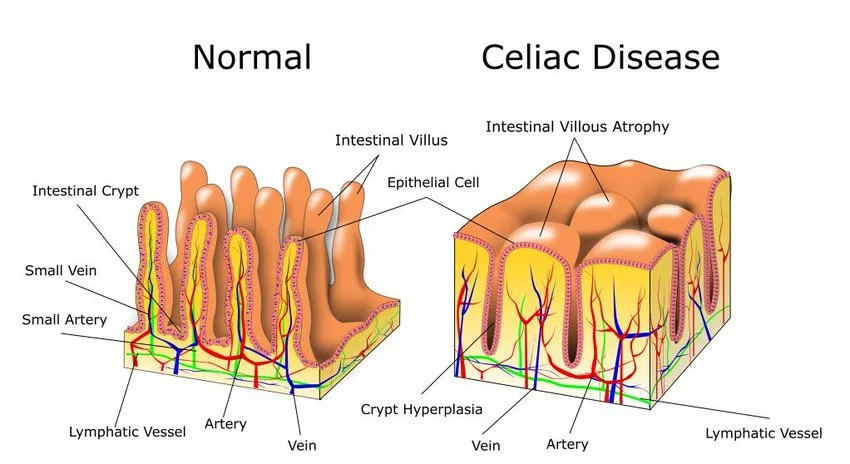
The main target of this autoimmune attack is the intestinal villi — the microscopic, hair-like projections that densely line the mucosal wall of the small bowel. Their job is to massively increase the intestine's surface area, enabling efficient absorption of macronutrients, vitamins, and minerals into the bloodstream. In someone with active Celiac disease, the sustained inflammatory response triggers a condition known as villous atrophy: the villi become severely inflamed, blunted, and eventually flatten completely. Once that happens, the intestine simply can't absorb nutrients properly, leading to profound systemic malnutrition no matter how much or how well you eat.
The Gluten Spectrum: Ubiquity and Cross-Contamination
Gluten is an umbrella term for a group of structural proteins — mainly gliadin and glutenin — found naturally in cereal grains, most notably wheat, barley, and rye. It's the ingredient that makes bread chewy and gives pasta and cakes their structure, which is exactly why it's so deeply embedded in modern food production.
But managing a strict gluten-free diet goes far beyond skipping bread and pasta. Because of its structural properties, the food industry routinely uses gluten as a binding agent, thickener, and flavor enhancer in processed foods. It shows up in soy sauces, malt vinegars, salad dressings, canned soups, and processed meats — and even outside the kitchen, in certain medications, vitamin supplements, and lip balms. Beyond hidden ingredients, people with Celiac disease also need to stay vigilant about cross-contamination. Food prepared on the same surfaces, fried in the same oil, or handled with the same utensils as gluten-containing items can carry enough trace gluten to set off a serious mucosal inflammatory response — even if the food itself appears to be gluten-free.
Clinical Presentation and Symptomatology
Celiac disease has a reputation in clinical circles as a chameleon. Its presentation is notoriously heterogeneous — symptoms can range from severe and debilitating to completely absent (so-called silent Celiac disease), even as significant intestinal damage accumulates in both cases.
Gastrointestinal Manifestations
The classic symptoms start in the gut, driven by the malabsorption of fats and carbohydrates. Patients frequently deal with chronic, persistent diarrhea marked by steatorrhea — stools that are bulky, pale, abnormally foul-smelling, and hard to flush because of their high undigested fat content. That's typically accompanied by severe bloating, intense colicky stomach pain, and flatulence. In some cases, the damaged gut motility slows down enough to cause severe constipation instead.
Extra-Intestinal Manifestations
Because the disease essentially destroys the body's absorption mechanisms, a wide array of symptoms emerge well outside the gut. Chronic fatigue is one of the most common complaints, primarily driven by iron-deficiency anemia — the damaged intestine can't absorb dietary iron properly. Skin is another target: dermatitis herpetiformis, an intensely itchy, blistering rash that appears on the elbows, knees, and buttocks, is a well-recognized dermatological manifestation. Neurologically, patients may experience peripheral neuropathy (tingling in the extremities), persistent migraines, and the cognitive impairment commonly called "brain fog." Left untreated, the condition can also lead to osteoporosis from calcium malabsorption, infertility, and serious developmental delays or stunted growth in children.
Diagnostic Protocols and the Importance of Tracking
Diagnosing Celiac disease typically starts with blood work. Physicians screen for specific autoantibodies — most commonly Tissue Transglutaminase IgA (tTG-IgA) and Endomysial antibodies (EMA). If those markers come back elevated, the diagnosis is confirmed with an upper gastrointestinal endoscopy, during which a gastroenterologist takes multiple biopsies from the duodenum (the first section of the small intestine) to directly assess the degree of villous atrophy under a microscope.
This is critical: don't go gluten-free before you've been tested. The diagnostic tests depend entirely on measuring your body's active immune response to gluten and observing the resulting mucosal damage. If you cut out gluten early, the gut starts to heal and antibody levels fall — which frequently leads to a false-negative diagnosis and leaves the real cause of your symptoms unidentified.
Once you've received a positive diagnosis, the only medically accepted treatment is strict, lifelong adherence to a gluten-free diet — no exceptions. In this phase, careful data collection becomes an important recovery tool. Apps designed to track digestive output, dietary intake, and daily habits let patients monitor their mucosal healing over time. By documenting shifts in stool consistency using the Bristol Stool Scale, logging the frequency of abdominal distress, and keeping precise dietary records, you can quickly spot accidental cross-contamination events and bring accurate, detailed reports to your gastroenterology follow-ups. For managing dietary triggers, the Low-FODMAP diet is another evidence-based protocol sometimes used alongside gluten avoidance.
Diagnosing Celiac Disease: The Clinical Pathway
The road to a celiac diagnosis is often much longer than patients expect. In textbook cases, the pattern looks straightforward: chronic diarrhea, weight loss, anemia, positive blood tests, confirmatory biopsy. In reality, the disease frequently hides behind vague or extra-intestinal complaints such as fatigue, migraines, infertility, mouth ulcers, constipation, neuropathy, or stubborn iron deficiency. Many adults are first labeled with IBS, stress-related digestive problems, hemorrhoids, or “sensitive stomach” long before anyone considers an autoimmune enteropathy. That helps explain why multiple cohort studies have reported an average diagnostic delay measured in years — often around 6 to 10 years in adults, especially when symptoms are non-classic.
The first step is suspicion. Testing is particularly important in people with chronic diarrhea, recurrent bloating, unexplained weight loss, persistent iron-deficiency anemia, folate deficiency, osteoporosis at a young age, recurrent miscarriage, or a strong family history of celiac disease. Screening is also commonly recommended in higher-risk groups such as first-degree relatives of a confirmed patient and people with associated autoimmune disorders including type 1 diabetes and autoimmune thyroid disease. Because the disease can be “silent,” some patients have substantial villous damage before they ever develop dramatic gastrointestinal symptoms.
Serology usually comes next, and the preferred first-line blood test is tTG-IgA paired with a total serum IgA level. That second number matters because selective IgA deficiency is more common in celiac disease than in the general population; if a patient is IgA-deficient, a falsely reassuring tTG-IgA can occur. In that setting, physicians often use IgG-based tests such as deamidated gliadin peptide IgG or tTG-IgG. When the patient is still eating gluten, tTG-IgA performs well, with widely cited estimates around 93% sensitivity and 95% to 97% specificity in the right clinical context. Endomysial antibody testing is even more specific, although it is less commonly used as the first screening assay because it is more labor-intensive.
Positive blood tests are usually followed by upper endoscopy with duodenal biopsy. This remains the diagnostic gold standard for most adults. Gastroenterologists do not take just one sample: best-practice guidelines recommend multiple biopsies from the distal duodenum plus the duodenal bulb because celiac damage can be patchy. Under the microscope, pathologists often describe the findings using the Marsh classification. Marsh 1 means increased intraepithelial lymphocytes with preserved villous architecture. Marsh 2 adds crypt hyperplasia. Marsh 3 indicates villous atrophy, which may be partial, subtotal, or total depending on severity. Those histologic patterns, interpreted alongside serology and symptoms, help distinguish celiac disease from other causes of malabsorption or inflammation.
Genetic testing has a narrower but still important role. Almost all people with celiac disease carry HLA-DQ2 or HLA-DQ8, with HLA-DQ2 accounting for the large majority of cases. A negative HLA-DQ2/DQ8 result makes celiac disease very unlikely, which can be useful when the diagnosis is unclear or when someone started a gluten-free diet before proper testing. A positive result, however, does not confirm the disease because these genes are common in the general population and most carriers never develop celiac disease. Genetic testing is therefore best understood as an exclusion tool rather than a stand-alone diagnostic test.
Do not begin a strict gluten-free diet before completing medical testing unless a clinician specifically tells you to. Antibody levels and intestinal damage can improve after gluten withdrawal, making diagnosis far more difficult.
The entire pathway makes sense only if the patient is still consuming gluten. That is why many specialists recommend a deliberate “gluten-containing diet” during evaluation. Once the diagnosis is confirmed, the conversation changes completely: the focus shifts from proving the disease to preventing further mucosal injury, nutritional deficiency, and long-term complications.
Living with Celiac: The Strict Gluten-Free Diet
The only treatment proven to control celiac disease is a lifelong gluten-free diet, and in medical practice “gluten-free” has a very specific meaning. In many regulatory systems, including the United States and Europe, foods labeled gluten-free must contain less than 20 parts per million of gluten. That threshold is low enough for most patients to heal, but it also illustrates how strict the diet really is: celiac management is not about “mostly avoiding bread.” It is about reducing exposure to very small amounts of wheat, barley, and rye, day after day, for life.
Obvious gluten-containing foods include breads, pasta, pastries, cereal, beer, and most conventional baked goods. The harder part is the hidden gluten. Malt flavoring, malt vinegar, brewer's yeast, soy sauce, gravies, thickened soups, imitation meats, processed deli products, spice mixes, candy, and some restaurant fries can all be problematic. Even products that look safe may be contaminated if they are manufactured on shared equipment or prepared in shared kitchens. Oats deserve special mention: many people with celiac disease can tolerate pure, uncontaminated oats, but standard oats are frequently contaminated with wheat during farming and processing, so certified gluten-free oats are the safer choice and are best introduced with clinical guidance.
Cross-contamination is where many “mystery flares” happen. A dedicated gluten-free meal can still become unsafe if it touches a shared toaster, wooden cutting board, colander, fryer oil, butter dish, or breadcrumb-covered countertop. At home, that may mean separate toaster slots, separate jars for spreads, and careful cleaning of pans and utensils. In restaurants, it means asking not only whether a dish is gluten-free, but also whether it is prepared in a separate pan, with clean utensils, and away from flour-heavy surfaces. A salad with croutons removed at the last minute is not truly gluten-free, and fries from a shared fryer are a common trap.
Label reading becomes a core life skill. “Contains wheat” warnings are helpful, but their absence is not enough because barley and rye are not always highlighted in the same way. Terms like malt, barley extract, triticale, modified food starch, and “natural flavors” may require closer scrutiny depending on the product and country-specific labeling rules. Medications, supplements, communion wafers, and even some oral-care products can also be relevant. Pharmacists and manufacturers can help clarify whether an excipient contains gluten when packaging is unclear.
Then there is the nutritional side of recovery. Untreated celiac disease commonly produces iron deficiency, folate deficiency, vitamin B12 deficiency, vitamin D deficiency, and calcium insufficiency because the damaged small intestine is absorbing poorly. Zinc and magnesium can also run low in some patients. Once people remove gluten, they often feel better quickly, but healing the gut and correcting deficiencies can take much longer. That is why follow-up care usually includes repeat blood work and, in selected patients, bone density assessment. A dietitian experienced in celiac disease can help replace calories from ultra-processed “gluten-free” substitutes with foods that are naturally nutrient-dense: legumes, dairy if tolerated, eggs, meat, fish, potatoes, rice, corn, quinoa, fruits, vegetables, nuts, and seeds.
Eating out safely is possible, but it requires planning and confidence. Good questions include: Is there a separate fryer? Is the sauce thickened with flour? Can the dish be cooked in a clean pan? Can staff change gloves and use a clean prep area? Chain restaurants may publish allergen menus, but individualized conversations still matter because kitchen practices differ by location. Many experienced patients learn to identify low-risk cuisines, carry backup snacks, and communicate clearly that celiac disease is an autoimmune condition requiring strict avoidance rather than a preference-based diet.
Feeling better after “mostly” avoiding gluten does not mean the intestine is fully protected. In celiac disease, small recurring exposures can sustain inflammation even when symptoms are mild.
Secondary Conditions and Long-Term Complications
Celiac disease is often discussed as a digestive disorder, but its complications are systemic because malabsorption and chronic immune activation affect the whole body. One of the best-known associated conditions is dermatitis herpetiformis, an intensely itchy, blistering rash caused by IgA deposits in the skin. Some patients with dermatitis herpetiformis have relatively mild gastrointestinal complaints, yet they still have the same underlying gluten-driven immune process and often the same need for a strict gluten-free diet.
Bone health is another major concern. The combination of chronic inflammation and poor calcium and vitamin D absorption can lead to osteopenia or osteoporosis, sometimes at surprisingly young ages. Fracture risk is higher in untreated or long-delayed disease, which is one reason clinicians may order bone mineral density testing after diagnosis, especially in adults with long-standing symptoms, low body weight, prior fractures, or postmenopausal status. The encouraging part is that mucosal healing and nutritional correction usually improve bone metabolism over time, particularly when the diagnosis is made before years of silent damage accumulate.
Reproductive and neurological effects are also well documented. Untreated celiac disease has been associated with delayed puberty, menstrual irregularity, subfertility, recurrent pregnancy loss, and poor pregnancy outcomes in some studies, likely because chronic inflammation and nutrient deficiency affect hormonal and placental health. Neurologically, patients may develop peripheral neuropathy, ataxia, migraines, cognitive slowing, or the “brain fog” that many describe during active disease or after accidental gluten exposure. These symptoms can be easy to dismiss until the underlying autoimmune trigger is recognized.
At the severe end of the spectrum sits refractory celiac disease, a rare but serious condition in which symptoms and villous atrophy persist despite a carefully verified gluten-free diet for at least 12 months. Before that label is applied, specialists usually look hard for more common explanations such as hidden gluten, microscopic colitis, pancreatic insufficiency, lactose intolerance, bacterial overgrowth, or another autoimmune disorder. True refractory celiac disease requires expert management because it may need immunosuppressive therapy and closer monitoring.
There are also uncommon malignancy-related concerns. Long-standing untreated celiac disease is associated with an increased risk of enteropathy-associated T-cell lymphoma and certain small-bowel cancers, although these remain rare overall. The absolute risk for any one person is still low, but the association is one reason doctors take strict dietary adherence so seriously. The same is true for persistent anemia, unexplained weight loss, severe diarrhea, and ongoing villous atrophy despite treatment — they deserve medical follow-up rather than reassurance alone.
The reassuring message is that strict treatment dramatically changes the long-term picture. For most patients, a genuinely gluten-free diet reduces inflammation, corrects deficiencies, lowers complication risk, and improves quality of life. Symptoms may improve within weeks, but full mucosal healing can take months to years, especially in adults. That lag is important: if someone feels better but continues small exposures, intestinal injury may continue silently. Good follow-up therefore combines symptom review, laboratory monitoring, and practical support for diet adherence.
Tracking Gluten Reactions with Happy Poop
Accidental gluten exposure is one of the hardest parts of living with celiac disease because the trigger and the reaction are often separated by time. Many patients notice abdominal pain, bloating, urgency, fatigue, or loose stool within about 12 to 48 hours of exposure, but the timeline varies widely. Some react within hours; others feel the consequences the next day; some notice neurological symptoms or rash more than gastrointestinal symptoms. Without tracking, it is easy to miss the connection between a restaurant meal on Saturday and a run of abnormal stools on Sunday night or Monday morning.
That is where structured logging becomes useful. When you record meals, symptoms, and stool form together, you can reconstruct the sequence of an exposure much more accurately than memory allows. In celiac disease, the stool pattern after contamination may shift toward looser or more urgent bowel movements, bulky malabsorptive stools, or an alternating cycle of diarrhea and constipation. Logging those changes with the Bristol Stool Scale gives you objective data rather than a vague impression that you were “off for a few days.”

Happy Poop is particularly useful here because it combines food diary entries, stool logging, symptom tracking, and custom traits in one timeline. You can create traits such as “possible gluten exposure,” “ate at restaurant,” “shared fryer,” “unknown sauce,” or “certified gluten-free meal,” then compare those markers against bloating, pain, and Bristol type over the next several days. The correlation chart helps you see whether accidental exposures consistently lead to a similar pattern — for example, abdominal cramping that appears that evening, Type 6 stools the next morning, and fatigue later that day.
The Dashboard also includes Zeps, Happy Poop's beetle mascot and AI assistant. Zeps can analyze your logged history and answer questions such as: “Do restaurant meals correlate with my worst symptoms?”, “How long after a likely gluten exposure do my stools change?”, or “Am I getting more loose stools after eating out than after food prepared at home?” That kind of review does not replace medical care, but it can be extremely practical when you are trying to identify hidden contamination routes and explain your experience during follow-up appointments.
If you have celiac disease and a symptom flare keeps repeating, log the suspected exposure immediately and keep tracking for at least 48 hours. The delay between trigger and reaction is often the key to identifying hidden gluten.
Over time, tracking also provides reassurance. Not every bad day is caused by gluten, and not every digestive symptom means you have failed the diet. A clear timeline can separate accidental exposures from unrelated infections, stress, menstrual changes, or other digestive triggers. That makes your data more useful — both for your own decisions and for your gastroenterologist or dietitian.






Sources & Medical References: