The Low-FODMAP Diet: A Clinical Protocol for Managing IBS and SIBO
Understanding the biochemistry of carbohydrate fermentation and how to identify your unique dietary triggers.
What Does FODMAP Actually Mean?
The term FODMAP is an acronym developed by researchers at Monash University to group together specific types of short-chain carbohydrates (sugars and fibers) that the human digestive system struggles to process. The acronym stands for:
- Fermentable: Carbohydrates that are easily broken down by bacteria in the gut, producing gas as a byproduct.
- Oligosaccharides: Fructans and GOS (found heavily in wheat, rye, onions, and garlic).
- Disaccharides: Lactose (found in dairy products like milk, yogurt, and soft cheeses).
- Monosaccharides: Fructose (found in honey, high-fructose corn syrup, and fruits like apples and pears).
- And Polyols: Sugar alcohols such as sorbitol and mannitol (found in some fruits/vegetables and often used as artificial sweeteners).
The Biochemistry of Digestive Distress
In a person with a perfectly functioning gut, eating high-FODMAP foods causes little to no issue. But for people with Irritable Bowel Syndrome (IBS) or Small Intestinal Bacterial Overgrowth (SIBO), these specific carbohydrates set off a cascade of severe physical distress.
The reason? These short-chain carbohydrates don't absorb well in the small intestine—they travel through relatively intact and land in the large intestine (colon). Once there, two things happen:
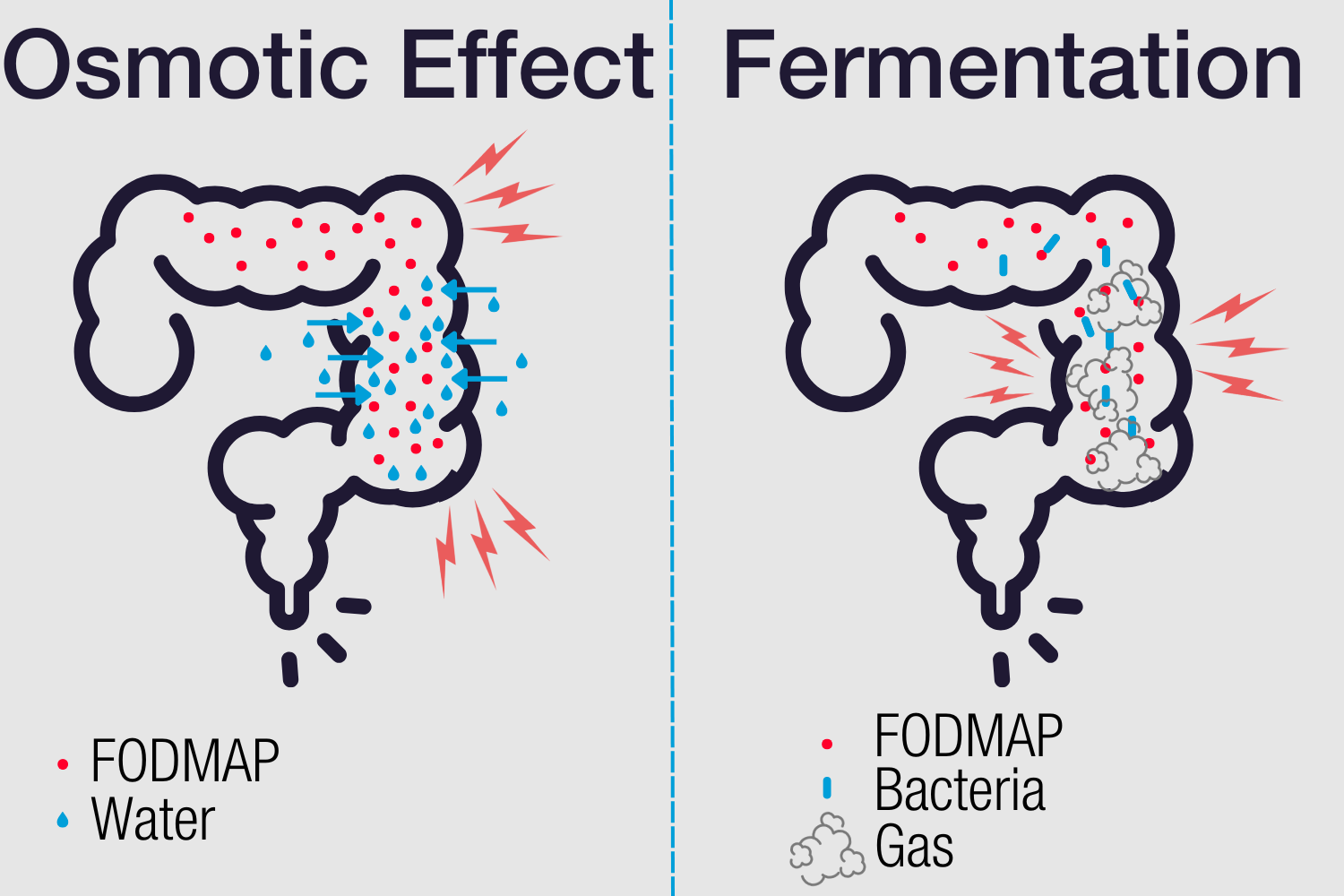
- Osmotic Action: FODMAPs are highly osmotic, meaning they draw massive amounts of water into the bowel. This sudden influx of fluid rapidly alters bowel motility, frequently resulting in acute, watery diarrhea (Bristol Scale Types 6 and 7).
- Bacterial Fermentation: The millions of bacteria residing in the colon begin to rapidly feed on these undigested carbohydrates. The fermentation process produces large volumes of hydrogen and methane gas. This gas rapidly expands the bowel wall, causing severe bloating, visible distension, and agonizing cramping due to visceral hypersensitivity.
The Three-Phase Protocol
Here's what's often misunderstood: the Low-FODMAP diet is a temporary diagnostic tool, not a permanent way of eating. It's designed to calm the gut and identify your specific triggers, and it should be executed in three distinct phases:
Phase 1: Elimination (2 to 6 Weeks)
During this strict phase, all high-FODMAP foods are completely removed from the diet. The goal is to establish a baseline—where symptoms like bloating, pain, and unpredictable bowel habits significantly reduce or disappear entirely.
Phase 2: Reintroduction (6 to 8 Weeks)
Once symptoms have stabilized, individual FODMAP groups are systematically reintroduced one at a time, in increasing portion sizes. For example, you might test Fructans by eating a small amount of garlic on day one, then a larger amount on day two, monitoring closely for any symptom relapse.
Phase 3: Personalization
After testing all groups, you build a personalized, modified diet. Most people find they're only sensitive to one or two specific FODMAP categories—highly reactive to Lactose and Polyols, say, but perfectly fine with Fructans. The goal is to return to the least restrictive diet possible while staying symptom-free.
Dietary Guidelines and Substitutions
High FODMAP (Avoid during Phase 1)
- Dairy: Cow's milk, yogurt, ice cream.
- Grains: Wheat-based bread, pasta, cereals.
- Vegetables: Garlic, onions, asparagus, artichokes, cauliflower.
- Fruits: Apples, cherries, peaches, watermelon.
- Legumes: Beans, lentils, chickpeas.
Low FODMAP (Safe during Phase 1)
- Dairy Alt: Almond milk, lactose-free milk, hard cheeses (cheddar, brie).
- Grains: Oats, quinoa, rice, 100% spelt bread.
- Vegetables: Zucchini, eggplant, potatoes, tomatoes, cucumber.
- Fruits: Blueberries, strawberries, oranges, kiwi.
- Proteins: Eggs, firm tofu, plain chicken, beef, fish.
The Importance of Medical Supervision
Clinical research shows the Low-FODMAP protocol reduces IBS symptoms in up to 86% of patients—but doing it alone is genuinely hard. High-FODMAP foods contain prebiotic fibers that are essential for feeding beneficial gut bacteria. Restricting all FODMAPs permanently is medically dangerous and leads to a severely compromised gut microbiome.
Managing IBS Flare-Ups?
FODMAP sensitivity is one of the primary drivers of Irritable Bowel Syndrome (IBS). Successfully navigating the Reintroduction Phase requires meticulous data collection to find your exact carbohydrate threshold.
Start Your FODMAP Diary NowThe Science Behind FODMAP Fermentation and Symptoms
FODMAPs cause trouble because they are small carbohydrates with one thing in common: they are either poorly absorbed or not absorbed at all in the small intestine. The reason varies by carbohydrate. Humans do not produce the enzymes needed to break down fructans and galacto-oligosaccharides (GOS), so those compounds inevitably pass onward. Lactose becomes a problem when lactase activity is low. Fructose absorption depends on intestinal transporters that can be easily overwhelmed, especially when fructose is consumed in excess of glucose. Sugar alcohols such as sorbitol and mannitol are simply absorbed very slowly.
Once these carbohydrates remain in the intestinal lumen, they start exerting an osmotic effect before they ever reach the colon. Water is drawn into the small bowel to equalize the concentration of dissolved particles. In some people that extra luminal water translates into gurgling, urgency, and loose stool within a few hours. When the unabsorbed carbohydrate load continues into the colon, the second stage begins: fermentation.
Colonic bacteria rapidly metabolize these short-chain carbohydrates and produce gases such as hydrogen, carbon dioxide, and in some individuals methane. That rapid gas production stretches the bowel wall. In a person with visceral hypersensitivity, which is common in IBS, even a modest amount of distension can feel dramatic: pressure, cramping, visible bloating, or the sensation that the abdomen has suddenly become tight. This is why a meal rich in onion, garlic, wheat, and apple can produce symptoms far out of proportion to the amount eaten.
Fermentation also changes motility. Hydrogen-producing fermentation is often associated with faster transit and looser stools, while methane production is linked in multiple studies to slower transit and constipation-predominant symptoms. That helps explain why two people can eat the same high-FODMAP meal and have opposite outcomes: one rushes to the bathroom with urgent diarrhea, while the other feels distended and constipated the next day.
The same dose does not affect everybody equally because FODMAP sensitivity is not just about the food itself. Microbiome composition matters: a colon dominated by highly fermentative species will generate gas differently than one with fewer gas-producing organisms. Small bowel transit speed matters too. If intestinal contents move slowly, the bowel is exposed to the osmotic load for longer; if they move quickly, the carbohydrate reaches the colon sooner and may produce a more abrupt post-meal flare. Meal size, stress level, underlying IBS, SIBO, and the total FODMAP load across the day all influence the final symptom pattern.
That is why the low-FODMAP diet works best as a structured experiment rather than a list of forbidden foods. Its goal is to reduce the fermentable load enough to calm the gut, then determine which specific subgroup, dose, and context actually provoke symptoms in that individual person.
A Practical FODMAP Food Reference
A low-FODMAP plan is easier to follow when it is framed as substitutions rather than deprivation. During the elimination phase, the practical question is not “what can I never eat again?” but “what can I swap in for the next few weeks while I establish a clean baseline?”
Common high-FODMAP foods include wheat and rye breads and pastas, garlic and onion, fruits such as apple and watermelon, cow's milk, many legumes, several mushrooms, and honey. These foods are nutritious, but they are frequent symptom triggers because they contain fructans, lactose, excess fructose, GOS, or polyols in clinically meaningful amounts. Garlic and onion are especially notorious because even small amounts in sauces, broths, marinades, and seasoning blends can provoke symptoms in fructan-sensitive patients.
Useful low-FODMAP alternatives include rice and quinoa instead of wheat-heavy grains, chives or the green tops of spring onions instead of onion bulbs, banana and blueberry instead of apples or watermelon, and lactose-free milk instead of regular milk. For protein, firm tofu is often well tolerated because much of the fermentable carbohydrate is removed during processing. Canned, well-rinsed lentils are another useful exception: some of their GOS leaches into the canning liquid, so smaller portions are often tolerated far better than dried-cooked lentils. Among mushrooms, oyster mushrooms are generally lower in polyols than common button or portobello mushrooms.
Portion size still matters. A food may be low FODMAP in one serving and high FODMAP in a larger one, which is why clinically validated serving guides are more useful than simple “yes/no” lists. Patients often discover that they do not need to exclude an entire food category forever; they only need to respect a threshold.
- Higher-FODMAP staples to pause temporarily: wheat bread, rye crackers, milk, soft cheese, hummus, beans, garlic, onion, apples, pears, watermelon, mushrooms, honey.
- Lower-FODMAP swaps for Phase 1: rice, quinoa, oats, potatoes, lactose-free dairy, hard cheese, eggs, chicken, fish, firm tofu, canned rinsed lentils, bananas, blueberries, citrus, zucchini, cucumber, tomatoes, oyster mushrooms, chives.
The critical point is that this is not a permanent ban. The elimination phase is intentionally short and restrictive so symptoms can settle. After that, the diet should expand again through structured challenge testing. The end goal is not a tiny “safe foods” list; it is the broadest diet your gut can tolerate consistently.
The Three Phases of the Low-FODMAP Diet
The low-FODMAP diet is often described as a diet, but clinically it behaves more like a protocol. Each phase has a different purpose, and patients run into trouble when they stay stuck in Phase 1.
Phase 1: Strict Elimination (2-6 Weeks)
This is the reset phase. For roughly two to six weeks, the goal is to reduce overall fermentable carbohydrate exposure enough to see whether symptoms such as bloating, pain, diarrhea, constipation, or post-meal urgency improve. If symptoms have not clearly improved after a well-executed elimination period, the next step is not indefinite restriction; it is reconsidering the diagnosis, the accuracy of food selection, and possible overlap conditions such as celiac disease, IBS, or SIBO.
Phase 2: Systematic Reintroduction (6-8 Weeks)
Once the gut is calmer, each FODMAP subgroup is tested one at a time. A practical method is to challenge one subgroup every three days, using increasing portions while everything else in the diet stays stable. This allows a patient to ask a very specific question: “Do I react to this category, at this dose, when my baseline is otherwise quiet?” Reintroduction commonly targets:
- Fructose
- Lactose
- Sorbitol
- Mannitol
- Fructans
- GOS
- Polyols more broadly when mixed exposures are relevant
In practice, many dietitians separate sorbitol and mannitol because tolerance can differ. If a challenge triggers symptoms, the patient returns to baseline eating until symptoms settle, then moves to the next category. The purpose is not to “pass” every test; it is to identify individual triggers and dose limits with as little guesswork as possible.
Phase 3: Personalisation
This is the long-term phase and the one that matters most. All tolerated FODMAPs are brought back in, and partially tolerated foods are included at tolerable doses. Someone may learn that lactose is fine in yogurt but not in milk, that garlic is a problem but onion tops are tolerated, or that fructose only becomes an issue when several high-fructose foods are eaten in the same day. That personalized pattern is far more useful than a generic app list.
The final diet should include as many tolerated foods as possible, both for quality of life and for microbiome diversity. A successful low-FODMAP protocol ends with more clarity, not more fear.
FODMAP and the Gut Microbiome Trade-off
One reason gastroenterology dietitians caution against staying on a strict low-FODMAP diet for months is that many FODMAP-containing foods are also major sources of prebiotic fiber. Fructans from onions, garlic, and wheat, along with GOS from legumes, are not nutritionally useless irritants. In many people they are valuable fuel for beneficial gut bacteria.
When those substrates are removed for too long, symptoms may improve while microbiome diversity quietly narrows. Several studies have shown that prolonged low-FODMAP restriction can reduce the abundance of Bifidobacteria, a genus generally associated with healthy carbohydrate fermentation, gut barrier support, and production of beneficial metabolites. That does not mean the low-FODMAP diet is harmful when used correctly. It means the elimination phase is a strategic short-term tool, not a maintenance lifestyle.
This trade-off matters clinically. A patient who remains on a strict elimination diet for six months may feel less bloated, but they may also be avoiding a large proportion of the fibers that support short-chain fatty acid production and broader microbial resilience. Over time, that can mean a less adaptable gut ecosystem and a diet that becomes progressively harder to liberalize.
That is why reintroduction is critical for gut health, not just for palatability or social convenience. The purpose of Phase 2 is to rescue every food and every FODMAP subgroup that the patient can reasonably tolerate. Even partial tolerance matters. If wheat is a problem in a large pasta dish but not in one slice of sourdough, or if canned lentils are tolerated while chickpeas are not, those foods deserve a place in the long-term plan because they expand fiber diversity and microbiome fuel.
Clinically, the best low-FODMAP outcome is not “no symptoms at any cost.” It is symptom control with maximal dietary diversity. That balance is what protects the microbiome while still respecting the patient's trigger profile.
Tracking Your FODMAP Reintroduction with Happy Poop
Reintroduction only works if each challenge is documented well enough to compare one exposure with the next. Happy Poop makes that much easier because you can log the test food in the food diary, then pair it with the bowel data that actually matters: stool timing, Bristol type, color, urgency, and the abdominal symptoms that often decide whether a challenge counts as a fail. Adding mood and custom traits such as bloating, gas, and cramping turns a vague memory of “I think garlic bothered me” into a time-stamped record you can review days later.
That matters because FODMAP reactions are often delayed or mixed. A fructan challenge might cause bloating within two hours, then a Type 6 stool the next morning. A lactose challenge may produce only gas and cramping without diarrhea. When every challenge is logged the same way, the pattern becomes far easier to interpret.
The app's AI Analyze button can also speed up bowel logging during a challenge period. If you take a photo at the log entry screen, the AI can auto-fill the Bristol type, color, and quantity, reducing the friction of keeping detailed records when you are testing several foods over multiple weeks.
On the Dashboard, Zeps reviews your logged history and helps you look for correlations between specific reintroduction entries and symptom flares. That is especially useful when the pattern is subtle, such as symptoms appearing only when fructans are combined with stress, or only above a certain portion size. Instead of scanning dozens of entries manually, you can ask Zeps to summarize what happened after your last lactose or onion challenge and which traits spiked afterward.

The most useful reintroduction diary is boringly consistent: log the challenge food, portion size, Bristol type, mood, and bloating or cramping traits every time. Consistency is what turns a restrictive elimination diet into a personalized long-term plan.






Sources & Medical References: